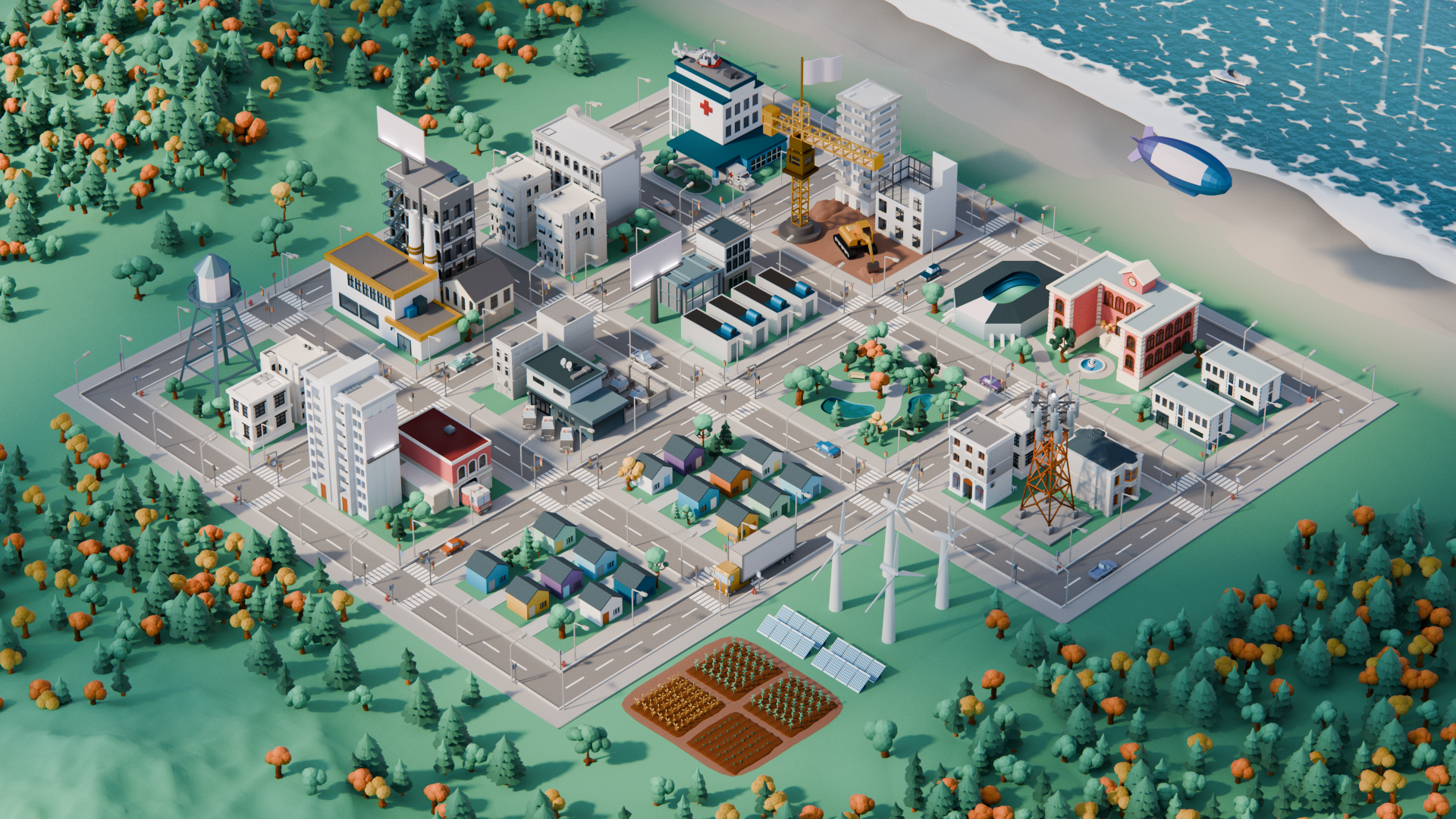
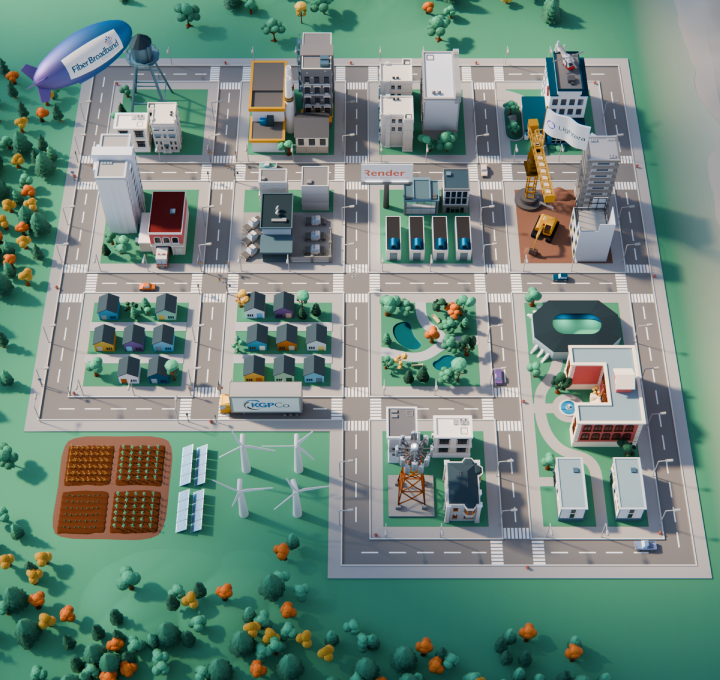
Fiber broadband connects communities and powers essential infrastructure, from homes and healthcare to manufacturing and municipal services. Fiber's symmetrical speeds, low latency, and massive throughput are key to enabling innovation in every sector.
Tap the hotspots on the map to explore how fiber impacts each area.
High-capacity, low-latency fiber is the engine for industrial automation. Ultra-low latency allows precision robotics to coordinate in real time, ensuring seamless assembly and maximum safety.
IoT sensors monitor every aspect of the facility and equipment, using fiber's massive throughput to manage huge volumes of data. The constant flow of data fuels AI-driven analytics and just-in-time operations, reducing waste and costly storage so manufacturing runs at peak efficiency.
Fiber broadband powers modern healthcare both in the hospital and at home. High-capacity fiber provides the symmetrical speeds needed to instantly and securely transfer large, data-rich files like 3D imaging and electronic medical records.
Telehealth visits, remote diagnostics, and and AI-assisted analysis keep patients and providers connected from afar. New advances in assistive technology allow seniors to live independently and safely for longer. Fiber provides the speed, capacity, and low latency that make it all possible.
Fiber networks provide durability and reliability for fire and police services to stay connected and operable in emergencies. Fiber keeps wildfire command centers connected for mapping and evacuation, and it keeps police departments operational during disasters when other grids fail. High-capacity fiber also powers city-wide CCTV and video feeds, providing first responders with the massive data flows needed to manage crises effectively.
Fiber enables smart grid modernization for utilities and other public services—everything from monitoring the power grid to connecting traffic lights and parking meters to unlocking administrative efficiencies. Fiber-connected sensors can detect ground movement, traffic flow, and infrastructure disruptions in real time, feeding AI systems that shift public safety from reaction to anticipation.
Fiber provides the essential infrastructure for AI and cloud computing. As AI adoption grows and models grow, edge data centers—placed closer to end users—depend on fiber for the massive throughput and ultra-low latency needed for real-time data processing. Emerging technologies like quantum computing and hyperscale data centers will only be possible with fiber.
Hollow core fiber takes it a step further by transmitting light through an air-filled core, enabling even lower latency and reduced signal distortion. This makes it especially valuable for AI workloads and hyperscale data centers, where massive data flows, real-time processing, and energy efficiency are critical. Unlike traditional fiber, hollow core fiber minimizes nonlinear effects and can deliver faster, more efficient data transmission at scale.
Connected construction uses high-capacity fiber to transform physical sites into digital hubs. By syncing massive 3D models in real time and enabling AR/VR design reviews, crews reduce costly rework and ensure pinpoint precision. Beyond the blueprints, fiber protects connected workers through AI-powered safety monitoring in high-risk zones and drives autonomous, AI-guided machinery.
As we build the future, fiber deployment requires a skilled workforce, creating jobs and upskilling opportunities for fiber-centered careers.
Fiber broadband connects households to work, entertainment, and smart home accessories at the speed of modern life. Fiber provides the symmetrical upload and download speeds needed for high-definition video conferencing, seamless remote work, content creation, 4K/8K streaming, and lag-free gaming. Backed by fiber, whole-home Wi-Fi supports all the household’s devices at once, with reliable connections to smart appliances and security systems that keep our homes running smoothly and safely.
For communities and homeowners, fiber is a future-proof investment with nearly limitless potential to grow with new technologies while increasing long-term home value.
Connected learning depends on fiber for the speed and capacity schools and universities need to support the entire campus. Fiber provides the massive throughput needed to keep hundreds or thousands of students connected at once, whether in the classroom or remote. Campus-wide Wi-Fi built on fiber keeps everyone connected in a blended learning environment.
Fiber removes barriers to modern education technology like smart classrooms and virtual labs—even supporting the growth of esports teams. In communities, fiber deployment helps reduce the homework gap, ensuring students have reliable home internet access to support their education.
Fiber broadband is an essential partner in modern agriculture and renewable energy. In rural communities, fiber provides the backhaul for fixed wireless networks, allowing smart machinery, drones, and soil sensors to transmit data from the field. Fiber’s speed and massive throughput allow all this data to flow seamlessly, feeding AI models that help farmers make informed, real-time decisions—even remotely. Real-time insights enable precision agriculture, helping farmers maximize crop yields while reducing water and fertilizer use.
For wind farms and renewable energy sites, low-latency fiber is critical for smart grid integration. Fiber-connected sensors monitor wind turbines and weather conditions in real time, allowing operators to balance energy loads and ensure a steady, reliable flow of clean power to the community.
Fiber is the foundation of 5G and fixed wireless networks. Fiber backhaul enables high-capacity, low-latency 5G connections. Fast, reliable 5G relies on fiber that reaches close to where users live and work.
In extreme conditions like high winds or fire, underground fiber networks are more protected than above-ground cell towers and power lines. So even if surface equipment is damaged, the core network remains active, helping restore communications more quickly.
Lightera is a global leader in optical fiber, data-center connectivity, and AI-ready infrastructure solutions. Our solutions enable faster, more reliable, and more sustainable connections—supporting the data centers that drive AI innovation and the intelligentnetworks that underpin smart communities. From high-capacity fiber to advanced connectivity architectures, Lightera helps businesses, cities, and industries build the resilient digital foundations needed for a smarter, more connected world.
Render is the system of execution for critical infrastructure, creating a shared operational truth across design, build operations and maintenance to reduce risk, protect margin, and accelerate return on capital. By connecting every phase of the asset lifecycle, Render helps bring smart communities to life, ensuring the infrastructure behind connected homes, businesses, and public services is delivered with the speed and precision that modern communities demand.
KGPCo is a strategic partner to the companies building today's digital infrastructure—delivering the supply chain, integration, and network solutions required to design, deploy, and scale fiber-powered communities. From sourcing and logistics to pre-integration and on-site deployment, we bring the people, processes, and partnerships together to turn complex builds into connected realities. Because smart communities aren't just imagined—they're engineered, integrated, and delivered.